Wednesday, August 29, 2012

Exhibition of Transformative Work


Last week, the 900 teachers of the York County School Division participated in a gallery walk, an exhibition of student and educator work. To start the day, teachers walked for ninety minutes with colleagues among 140+ exhibits presented by their peers. The exhibits included project descriptions, student work, assessment rubrics, assessment checklists, and other materials to help teachers "steal" ideas from one another. Following the gallery walk, each teacher participated in a series of three 20-minute small group discussions, each of which focused on one of the exhibitions.
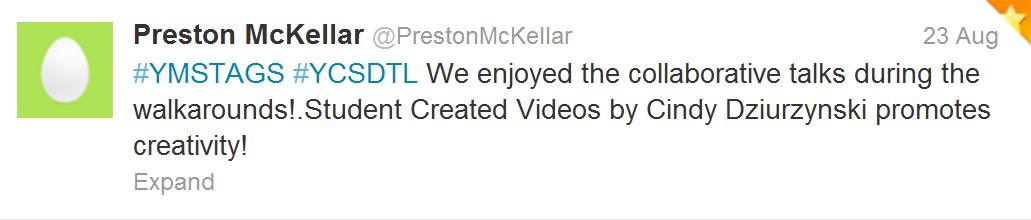
The tweets sent by participants provide a glimpse of the power of the exhibition. In addition to providing camaraderie, the exhibition generated three valuable benefits:

Learning from presenters and other participants;
Inspiring teachers to take action; and


Sparking further collaboration across the district.

The exhibition showcased examples of transformative learning. We define transformative learning as follows:

Transformative learning engages students in rigorous work that makes a difference. Students master the content and skills of the curriculum while making a positive impact on their local, state, national, and/or global community. Students are more likely to fully commit themselves to their work because transformative learning generates a sense of ownership by appealing to students’ desire for significance. Students use digital tools to improve and amplify the impact of their work.
When students make a difference through transformative learning they are accepting the challenge set forth by Angela Maiers and others to #Choose2Matter.
The exhibition featured work from all three levels: elementary, middle, and high school. Projects allowed students to learn the content and skills of the curriculum while making a difference in a variety of ways: reducing the waste of old cell phones, working to protect endangered species, designing healthy school lunch menus, managing charitable donations, creating book trailors to market books, promoting water conservation, and designing APPs. Here are three projects that involved students helping their peers:
Jennie MacBlane shared how her fourth grade students create instructional videos that are posted on YouTube to teach peers reading strategies. She emphasized that students took charge of the projects, serving in one of a variety of roles, such as Director, Head of Script Writers, Head of Filming, Actors, Filming Crew Members, and Production Crew members. As Alan November observes in describing the concept of the digital learning farm, she reports that students committed themselves fully to the work because they valued the work for more than a grade. For resources relating to this project, click here.

Sixth grade teachers Cindy Evans, Nancy Hehir, Becky Karatsikis, and Kelley Payne enlisted their students in supporting the transition of 5th grade students to middle school. Fifth grade students wrote letters to the 6th grade students asking questions about middle school. The sixth grade students wrote detailed letters in response. They then grouped the questions into categories such as lockers, the schedule, and homework and worked in groups to create video Public Service Announcements for the younger students to view. One teacher observed that some of her reluctant writers wrote lengthy responses and wrote multiple letters, although only one letter was required.
Emily Lerberg and Joyce Kuberek are examples of high school teachers engaging their students in making a difference while learning content and skills that are part of the curriculum. Their chemistry students create comic strips that reinforce and extend peers’ knowledge of Chemistry. Without any technical instruction from their Chemistry teachers, students used Bit Strips, ToonDoo, other digital tools, or free hand drawing to create comic strips relating to Chemistry content. Mrs. Kuberek shared this link to a video to explain the process of embedding a comic strip in Edmodo in order to publish work for a larger audience.
An excerpt of a student-created comic strip

These teachers are heros. They are working to resist the content coverage mentality that grips much of education. By giving students opportunities to make a difference through these projects, they increase the likelihood that students commit themselves fully to their work. They design projects that teach the curriculum, but they reject the short-term perspective of the content coverage mentality and seek deeper, longer-lasting mastery of content and skills.

These teachers are also heros because they shared their genius by presenting during the exhibition and small group discussions. In some districts, pockets of innovation exist in which teachers engage students in transformative learning. To move from pockets of innovation to consistent transformative learning throughout a school or district, a distributive model of leadership, including active teacher-leaders, is crucial.


After lunch, teachers gathered at their own schools to participate in a variety of activities relating to transformative learning. For example, staff members at some schools completed a jigsaw activity relating to excerpts of articles or books by Dan Pink, Phil Schlecty, Bill Daggett, and Robert Marzano. Each teacher joined a small groups and used a protocol from the National School Reform Faculty to make connections between transformative learning and one of the excerpts from an article or book. They then reconfigured the groups and discussed how each of the articles and books relate to Transformative Learning. Staff members at other schools used a protocol to discuss a blog post relating to the concept that student work can still be meaningful and valuable, even it is somewhat authentic or somewhat transformative, rather than fully authentic, transformative work. Another school used Today's Meet to discuss transformative learning. All three of these approaches were modeled recently at our Leadership Academy for teacher-leaders, school-level administrators, and central office leaders. 

The success of the day was based on the work of many people in addition to the exhibiting teachers. Ashley Ellis, Candi Skinner, Mike Lombardo, Len Donvito, and Stephanie Guy not only organized the day but have worked over the last several years to support teachers’ creation of engaging, rigorous projects. Our School Board members, Principals, Assistant Principals, Educational Technology Facilitators, Instructional Specialists, and others at central office and within schools have also provided teachers with support in recent years that contributed to the high quality of work exhibited.

We plan to build on the excitement and insight generated by the exhibition to engage students in transformative learning throughout the year!

You might also enjoy these posts:
Choose2Matter: Don't Underestimate Students
The Digital Learning Farm: A Call to Action
Fretting about Somewhat Authentic Projects
Students and Transformative Work

Sunday, August 26, 2012

Innovative Teachers: Share Your Genius

Here is an excerpt of a guest post that I published on the Cool Cat Teacher Blog. Click here for the full post. 
The world needs your unique talents and insights for engaging students in work that matters. Understanding and acting on this truth, as championed by Angela Maiers, can change the world.

Many innovative teachers, observed Alan November at #PILUS, prefer to focus on innovation rather than on promoting innovative instructional practices. Innovative teachers, let’s break this stereotype!
You have unique talents and insights for engaging students in work that matters. Some teachers almost instinctively identify the big ideas and important skills of their curriculum and design projects that allow students to master these concepts and skills. Other teachers brilliantly support students’ leveraging of technology to connect with a global audience for the students’ work. Still other teachers wow us with their ability to coach students’ collaboration with peers and adults. As Angela Maiers emphasizes, claim your genius by acknowledging your genius.
Choose2Matter, a hashtag created by Angela Maiers, reflects the notion of using one’s genius to change the world. The world needs your genius so Choose2Matter. Others will benefit from your genius and you will be enriched by the connections as well!

Monday, August 6, 2012

Angela Maiers Livestream

Check out the livestream of a keynote address by Angela Maiers from 8:15 a.m. to 9:30 a.m. EST on Tuesday, August 7. Although flight problems will preclude her presenting at the York County School Division in person, we plan to connect with her via videoconferencing and livestream the event.
To access the livestream, visit http://www.ustream.tv/channel/ycsd-tv

Join the conversation on Twitter that morning via the hashtag #ycsd13. My introductory remarks will also be live streamed starting at approximately 7:50 a.m.
In her remarks to teacher leaders, building-level administrators, and central office leaders of the York County School Division in Virginia, Angela Matters will issue a call to action: Choose2Matter. She will share her passion for engaging students in work that makes a difference locally, nationally, and globally. She will share the You Matter message and will articulate how teachers and students and use digital tools to improve and amplify the impact of their work.

Friday, July 27, 2012

Choose2Matter: Don’t Underestimate Students

Too many people, including educators and students, feel insignificant. But what happens when you know you matter and you understand that your actions count? What happens when you recognize that you are not only important, but essential? @AngelaMaiers poses these questions in advancing the You Matter (#YouMatter) movement.

As Angela observes, the You Matter movement both lifts us up and challenges us. We are lifted up by the recognition that each of us is a genius. We are challenged by the assumption that our contributions are needed by the world.
The implication for schools, states Angela, is that it is not enough to support student success. We must support students’ significance. We should focus on supporting student significance now, not just on preparing students for significance at some point in their future.
We are underestimating our students, emphasizes Angela. Our students need us to believe they are capable of doing world changing work. To illustrate this, Angela shares a video in which students ask teachers to “believe in me . . .trust me . . . hear me . . . inspire me . . . help me . . .empower me . . . honor me.”


Last week, four teachers from the York County School Division in Virginia joined Angela Maiers in spreading the You Matter message at the #BLC12 (Building Learning Communities 2012) Conference. They described examples of their students doing work that matters, meaningful work that makes a difference.

Charitable Investment Strategists
Third grade students at two separate elementary schools made decisions regarding how to invest actual donations in OxFam in a way that would provide the most benefit. The students researched the effectiveness of fertilizing soil with manure compared to fertilizing soil with worms. Each class focused on and advocated one fertilizing option. They wrote persuasive essays and performed persuasive skits via Skype to classes in other schools to convince the students in eight classes how to invest the donation. [presented by Elizabeth Hoffman and Melissa Overton (@2teachlearngrow); implemented with Eric Postman (@epostmanetf), Krystal Kosanovich (@MrsKosan), Regina Riddick, Regina Zimmerman, Brandi Bolling, and Jen Litts) 

Student Skypes to promote his class' charitable investment strategy.

Online Book Reviewers
Middle school students created and published online videotaped reviews of books available at the school library. Next year their reviews will be accessible via the school YouTube site and via QR codes affixed to books in the school library. When choosing a book at the school library, schools will be able to consider their peers’ recommendations by watching the book reviews. Because students are encouraged to bring their own digital devices to school, they will be able to go to the library and scan the QR code on a book with their smart phone, tablet, etc. ( or use a school-owned device) to see the book review. Alternatively, students will be able to access YouTube from home or school to see book reviews. (presented by  Jan Myers; implemented with Abby Paddua)


Producers of Video Tutorials
High school students created video tutorials that explained important biological concepts by relating the content to topics that are familiar to most people. For example, one pair of students posted a video tutorial that explained the biological concept of competitive exclusion by connecting it to the fiercely competitive academic climate among many contemporary high school students. (presented by Amy Holtschneider; @aholtschneider)
What happens when you know your actions count?
Knowing that their work had meaning beyond a grade, and knowing that the world needed their unique gifts, these students committed themselves fully to the work. Jan Myers observed that the middle school students who typically were reluctant readers were particularly engaged in creating the online book reviews. Elizabeth Hoffmann shared that the elementary students were so committed to advocating their charitable investment strategy that they clamored to skip recess and stay after school to work on the projects. After the investment decision was made, the students wanted to continue the work on their cause. They wanted to know how else they could raise money for OxFam. Clearly, the students were committed to their work. They were not just working for academic success: they were working to be significant. Each student knew, in the words of Angela Maiers, “I am a genius and the world needs my contribution.”
What can we each do?
The You Matter movement both lifts us up and challenges us. We need to let others know that they matter and that the world needs their gifts. As teachers, Principals, Superintendents, and other educators, we need to let our colleagues know that their work matters.

We also need to let students know that their work matters. We need to give them opportunities to do transformative work that makes a difference locally, nationally, and/or globally. We need to encourage them to #choose2matter.

Encouraging students to make their mark
Angela Maiers shared how participants can encourage students to make their mark by participating in International Dot Day on September 15-ish. Every year, on or about September 15th, tens of thousands of educators and students participate in International Dot Day, which is designed to encourage students to “make their mark.” The day is inspired by Peter Reynolds’ award-winning book The Dot. The Dot tells the story of Vashti, a girl who begins a journey of self-discovery after she is challenged by her teacher to “make her mark.” Activity ideas and free educator resources are available at www.fablevisionlearning.com/dotday .  Twitter hashtags for conversations relating to International Dot Day include #DotDay and  #makeyourmark.

Connecting the Dots
Doing work that matters, making one’s mark, is not a one day event, emphasized Angela Maiers. The You Matter movement seeks to connect the dots all year long by bringing together educators and students who share a passion for doing work that matters.
As Angela asks, are you ready to help change the world? If so, you need to believe that your students can make a difference. On September 15, ask your kids to make a dot, to make a difference. And then give them opportunities to make a difference during the year. Help us connect the dots by joining the #youmatter movement to collaborate with others on supporting students as they make a difference locally, nationally, and globally.

Learn more about our teachers' efforts to encourage students to Choose2Matter:
The Digital Learning Farm: A Call to Action
Students and Transformative Work
Using Technology to Transform Teaching and Learning

Tuesday, July 17, 2012

The Digital Learning Farm: A Call to Action

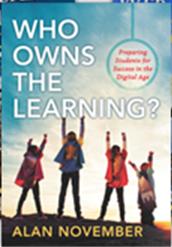
 In the recently released Who Owns the Learning, Alan November uses the metaphor of the Digital Learning Farm to articulate a compelling vision of learning and teaching.

He writes,
Not too many generations ago young people were expected to engage in work with purpose—caring for farm animals, repairing equipment, selling food at local markets, and helping to care for younger children in the family. . . Today we rarely expect young people to be contributors.
Alan issues a four-part call to action with the Digital Learning Farm model:
·         Engage students in work that has meaning to themselves and others;
·         Shift more control and responsibility to students by redefining the role of the learner as a contributor, collaborator, and leader; and
·         Leverage the powerful motivators of student ownership and purposeful contribution; and
·         Enlist inexpensive and easy-to-use technology to support students’ active participation and contribution to community.
Purpose-Driven Work
Who Owns the Learning is full of rich examples of students doing work that they and others value.
·         Students contribute as tutorial designers. Students create and post math tutorials for a global audience via their class’ Math Train web site.
·         Students who contribute as scribes: they collaborate to create a detailed set of notes for use by the entire class as well as by others around the world.
·         Students who contribute as researchers and authors of an online digital textbook.
Shift of Control
Alan observes, “we have inherited an organizational structure in which the teacher owns and manages the learning.” He further explains, “the questions (1) Who owns the learning? and (2) Who works harder in the classroom?” drive the thinking of the Digital Learning Farm model. Teachers still play a key role: “One of the most important tasks for educators . . . is finding the right beginning. Often that means identifying a single project the teacher can work through with the class, one that spawns new ideas for learning experiences.”

Leveraging Motivation of Student Ownership
This shift of control can be incredibly engaging. As Alan states, “students will work harder to achieve a purpose . . . than they will for a grade.” In his book, Alan quotes me in elaborating: These tutorial designers “were determined to get it right because they knew their video tutorials would be viewed by peers, both in their school and outside it. . . So you talk about who owns the learning. Those kids owned that.”
Enlisting Technology
Technology both connects students with resources to do meaningful work and a global audience. The Digital Learning Farm model taps into students’ interest in digital tools. As Alan puts it, “What if we could use the allure of Facebook, Twitter, YouTube and other similar tools to empower students to be autonomous, masterful, and purposeful in their academic work?”
As Alan November welcomes educators from around the globe for the Building Learning Communities 2012 conference, his latest book constitutes a call to action. He explains,
When students are given the opportunity to have purpose and ownership in their work, we see amazing things happen with the quality of their learning experiences and outcomes. We need more educational leaders and frontline teachers who are willing to empower students to co-create curriculum, own their learning, and make contributions to the collaborative process of learning.

Let us heed his call to action!

Two related blog posts by other authors via @jcoreyatzeck:

http://innovativelearningdesigns.ca/wordpress/?p=652

http://mylearn365.wordpress.com/2012/08/25/who-owns-the-learning/


Monday, June 25, 2012

Fretting About Somewhat Authentic Projects?

Advocates of project-based learning and other educators sometimes anxiously debate what constitutes authentic learning. When students are engaged in a scenario or simulation, should we consider this authentic learning? The mistaken assumption underlying this fretting is that if a project is not fully authentic, then it is not worth doing.  
Relax! In his recent blog post, John Larmer appropriately advises us to recognize that “somewhat authentic” learning, even if it is not as engaging as “fully authentic” learning, is still more likely to motivate students than learning that is not authentic.
Larmer describes a continuum. Writing an essay or report for one’s teacher is not authentic, although it can be valuable. Projects are “somewhat authentic” if students “are doing work that simulates what happens in the world outside of school.”  For example, it is “somewhat authentic” when students serve as an engineer or presidential advisor in a scenario or simulation.
Work is “fully authentic,” writes Larmer, if “the work has a direct impact on or use in the real world.” He cites as examples of “fully authentic” work: creating podcasts for visitors to local historic sites; and developing designs for a new play area in a nearby park.
I am not convinced that simulations constitute authentic work. Nonetheless, they can be very engaging so we can incorporate them in our classes even as we work to provide fully authentic learning experiences. As Larmer concludes, “fully authentic projects are often the most powerful and effective ones, because they are so engaging for students and allow them to feel like they can have an impact on their world . . .But if you can’t get there yet, don’t feel like you’re failing the authenticity test in your projects.”
Defining authentic work relates directly to discussions in our district regarding what constitutes “transformative learning.” Transformative learning occurs when students do work that makes a difference locally, nationally, and/or globally. Examples of transformative learning include the following performance tasks:
·         Elementary students implement a recycling plan on campus while learning about natural resources;
·         Middle School PE students add more joy to the lives of local senior citizens through square dancing performances; and
·         High School Driver’s Ed students use Claymation to create tutorials which they post for a global audience.

Clearly, transformative learning performance tasks meet Larmar’s definition of fully authentic projects because they have a direct impact on the world. As classroom teachers and other educators in York County, Virginia develop performance tasks, we sometimes struggle with whether a particular project constitutes transformative learning. For example, when students use the methods and tools of scientists to conduct research, are they engaged in transformative learning even if the results of their research do not make a difference in the world? Does it constitute transformative learning when students act as foreign policy advisors and create a mock plan for Obama and Congress for responded to an imagined attack by foreign forces? 
Even though I would not categorize these projects as transformative, they still are valuable. Even if you don’t agree with Larmer that scenarios and simulations are somewhat authentic, Larmar convincingly states that scenarios and simulations are often more engaging than traditional assignments. So, even if you value transformative learning, don't fret if your engaging performance tasks omit the opportunity for students to make an immediate difference in the world.

Saturday, June 16, 2012

Hunger Games Commencement

Commencement Remarks:
Welcome graduating students; family, friends, and teachers of graduating students; and School Board members. During this ceremony, we celebrate the commencement—the start of the next stage of the lives of our graduating students. We have confidence, graduating students, that individually and collectively you will flourish, regardless of the difficulties you face.
            Looking at our challenges relating to the economy, the environment, and international relations, one could mistakenly conclude that the world that the Class of 2012 inhabits resembles the combat arena in the popular book and movie The Hunger Games. In The Hunger Games one teenage boy and one teenage girl from each of a nation’s twelve districts are chosen by lottery to compete in a televised battle to the death until just one person remains. Although the arena in The Hunger Games is a horrific place, Katniss Everdeen, the sixteen year-old protagonist, inspires us with her capacity for love and selflessness, her work ethic, and her cunning intelligence.
            At the start of The Hunger Games, we learn of Katniss’ capacity for love and selflessness when her little sister Primrose is chosen by lottery for the death match and Katniss volunteers to go in her place. Graduating students, remember how compelling this capacity for love and selflessness is.
            Even before the lottery, we learn of Katniss’ strong work ethic. Given the limited resources and economic opportunity in her district, Katniss hunts for animals and plants every day in order to feed her family. Through countless hours of hard work, Katniss develops superior archery and outdoors skills that serve her well. Graduating students, take inspiration from this strong work ethic.
            The first story of The Hunger Games trilogy closes with a display of Katniss’ cunning intelligence. Midway through the story, the evil organizers of the game announce a rules change: rather than the game ending with one survivor, the game can end with two survivors from the same district. Every combatant in the games subsequently dies except for Katniss and Peeta, who is also from her district, making them the apparent victors. However, the organizers of the games, wanting more drama, announce a reversal of the rules change: the games will end when only one survivor exists. Katniss then outsmarts the manipulative organizers of the games. Knowing that the organizers would prefer two survivors rather than none, she hands poison berries to Peeta and prepares to take them herself, prompting the organizers to pronounce them both winners. Graduating students, know that cunning intelligence can outsmart people with evil intentions.
            I also encourage you to gain strength by connecting with others to pursue worthy causes. On the day of the lottery in The Hunger Games, the teenagers who were eligible for the misfortune of being chosen to compete gathered solemnly in the town square. After the youth witness Katniss volunteering to compete in the place of her younger sister, Effie Trinket, the mistress of ceremonies, tells them in the movie version, “Let’s have a big hand for our very first volunteer.” The teenagers recognized that the evil organizers of the games expected them to treat the games as a big festivity but they refused to applaud.  Instead, first one, then another, then almost every member of the crowd touched three fingers to their lips and held them in the air in an act of unity and support for Katniss. This act indicated appreciation and admiration and served to say good-bye.
            Lastly, I want to relate an expression that was insincere in The Hunger Games but that I share as a heartfelt wish, “May the odds be ever in your favor.” Congratulations, Class of 2012.