Showing posts with label Alan November. Show all posts

Sunday, August 26, 2012

Innovative Teachers: Share Your Genius

Here is an excerpt of a guest post that I published on the Cool Cat Teacher Blog. Click here for the full post. 
The world needs your unique talents and insights for engaging students in work that matters. Understanding and acting on this truth, as championed by Angela Maiers, can change the world.

Many innovative teachers, observed Alan November at #PILUS, prefer to focus on innovation rather than on promoting innovative instructional practices. Innovative teachers, let’s break this stereotype!
You have unique talents and insights for engaging students in work that matters. Some teachers almost instinctively identify the big ideas and important skills of their curriculum and design projects that allow students to master these concepts and skills. Other teachers brilliantly support students’ leveraging of technology to connect with a global audience for the students’ work. Still other teachers wow us with their ability to coach students’ collaboration with peers and adults. As Angela Maiers emphasizes, claim your genius by acknowledging your genius.
Choose2Matter, a hashtag created by Angela Maiers, reflects the notion of using one’s genius to change the world. The world needs your genius so Choose2Matter. Others will benefit from your genius and you will be enriched by the connections as well!

Tuesday, July 17, 2012

The Digital Learning Farm: A Call to Action

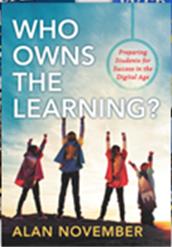
 In the recently released Who Owns the Learning, Alan November uses the metaphor of the Digital Learning Farm to articulate a compelling vision of learning and teaching.

He writes,
Not too many generations ago young people were expected to engage in work with purpose—caring for farm animals, repairing equipment, selling food at local markets, and helping to care for younger children in the family. . . Today we rarely expect young people to be contributors.
Alan issues a four-part call to action with the Digital Learning Farm model:
·         Engage students in work that has meaning to themselves and others;
·         Shift more control and responsibility to students by redefining the role of the learner as a contributor, collaborator, and leader; and
·         Leverage the powerful motivators of student ownership and purposeful contribution; and
·         Enlist inexpensive and easy-to-use technology to support students’ active participation and contribution to community.
Purpose-Driven Work
Who Owns the Learning is full of rich examples of students doing work that they and others value.
·         Students contribute as tutorial designers. Students create and post math tutorials for a global audience via their class’ Math Train web site.
·         Students who contribute as scribes: they collaborate to create a detailed set of notes for use by the entire class as well as by others around the world.
·         Students who contribute as researchers and authors of an online digital textbook.
Shift of Control
Alan observes, “we have inherited an organizational structure in which the teacher owns and manages the learning.” He further explains, “the questions (1) Who owns the learning? and (2) Who works harder in the classroom?” drive the thinking of the Digital Learning Farm model. Teachers still play a key role: “One of the most important tasks for educators . . . is finding the right beginning. Often that means identifying a single project the teacher can work through with the class, one that spawns new ideas for learning experiences.”

Leveraging Motivation of Student Ownership
This shift of control can be incredibly engaging. As Alan states, “students will work harder to achieve a purpose . . . than they will for a grade.” In his book, Alan quotes me in elaborating: These tutorial designers “were determined to get it right because they knew their video tutorials would be viewed by peers, both in their school and outside it. . . So you talk about who owns the learning. Those kids owned that.”
Enlisting Technology
Technology both connects students with resources to do meaningful work and a global audience. The Digital Learning Farm model taps into students’ interest in digital tools. As Alan puts it, “What if we could use the allure of Facebook, Twitter, YouTube and other similar tools to empower students to be autonomous, masterful, and purposeful in their academic work?”
As Alan November welcomes educators from around the globe for the Building Learning Communities 2012 conference, his latest book constitutes a call to action. He explains,
When students are given the opportunity to have purpose and ownership in their work, we see amazing things happen with the quality of their learning experiences and outcomes. We need more educational leaders and frontline teachers who are willing to empower students to co-create curriculum, own their learning, and make contributions to the collaborative process of learning.

Let us heed his call to action!

Two related blog posts by other authors via @jcoreyatzeck:

http://innovativelearningdesigns.ca/wordpress/?p=652

http://mylearn365.wordpress.com/2012/08/25/who-owns-the-learning/


Sunday, May 27, 2012

Transformative Learning: 3 Examples of Students Engaged in Work that Makes a Difference

 a guest post by Mike Lombardo (@mlombardo99), Principal, Magruder Elementary School, originially posted on his blog at http://principallombardo.blogspot.com/

How do you motivate students within the classroom?  As 21st century educators, we are well aware of the necessity to provide our students with rigorous and engaging learning experiences.  In addition, we know that our students expect to use digital tools in order to access the world and enhance their learning. 

After attending a January 2012 talk by Alan November (@globalearner), I began to reflect on my beliefs related to student engagement and the factors that motivate students to learn.  Alan November suggested that students are motivated when their work makes a difference, they have a sense of ownership, and their work transforms the learning of others.  Daniel Pink (@DanielPink) provides additional clarity to the issue of student engagement and motivation by arguing that student work must have a purpose. 

The following examples showcase transformative learning experiences in which the students were highly motivated due to the design of the work.  In each example, the students’ work made a difference, created a sense of ownership, and added information that aided in the learning of others.  In addition to these critical attributes, the use of digital tools in order to share the students' work beyond the classroom is a common characteristic of each learning activity.


Video of Classroom Procedures
Each fall, teachers begin the year by establishing clear classroom procedures with the students.  The procedures are then reviewed and practiced until the students have a strong understanding of the routines and the classroom is functioning like a well-oiled machine.  In Mrs. Caruso's (@CarusoM1) classroom, this process became a transformative learning experience for her students.  The students created videos for each of the established classroom procedures using Movie Maker.  Within each video, the students enacted the procedure, providing powerful demonstrations of the desired routine.  Creating the videos was a tremendous strategy for reinforcing the procedures for her current students.  However, the learning experience became transformative due to the fact that next year's students will view the videos in order to learn the classroom procedures.  They will of course be charged with creating new videos for the students who will be in Mrs. Caruso's class the following year. 
  
Long Division Claymation
The long division algorithm provides a daunting challenge to teachers in regards to student engagement and understanding.  Rather than simply practicing the steps involved in the process via rote learning, students in this example created Claymation videos.  Prior to developing the Claymation videos, cooperative groups of students created stories to represent their division problems and bolster understanding of the mathematical concept.  Then, using digital cameras and video editing software, the students created the Claymation products by taking photographs of their clay representations of division problems.  Through the Claymation process, they were able to convert the still photographs into a sequential video and gain a greater understanding of the long division algorithm.  Finally, once their Claymation videos were complete, they were uploaded to the school’s network and YouTube.  In doing so, the products added to the body of information and allowed others to learn from their work. 

Scientific Method Music Video
Utilizing the scientific method is a powerful process for students, providing them with a systematic means of exploring their world and drawing conclusions based on their investigations.  For Mrs. Hodges’ (@Hodgesvj) fourth grade students, the motivation for mastering the scientific method was evident from the moment she proclaimed that the class would be responsible for creating a music video regarding the topic.  The students were immediately able to take ownership of the work as they began planning the video.  Through the production of their music video, the students were able to emphasize critical components of the scientific method such as; making observations, predicting, identifying variables, and drawing conclusions based on data.  In this transformative learning experience, the students realized the profound purpose of the work since the product would be posted on YouTube so that others could learn from their scientific method music video. 

In the aforementioned examples, Alan November and Daniel Pink’s concept of motivation and transformative learning was clearly evident.  In each case, the students were motivated due to the work having purpose beyond a grade or assigned requirement.  The students took great pride in their work, knowing that it would be accessed by others far beyond the classroom.  In addition, the learning activities were transformative by design.  The students' work made a difference, created a sense of ownership, and added information that aided in the learning of others.  In our unwavering efforts to provide students with a world-class education, it is vital to create transformative learning experiences in which our students are motivated, engaged, and able to see the value of their work.

Saturday, March 10, 2012

Transformative Work: Work That Matters

Who owns the work? Giving students the opportunity to a make a difference in the world around them increases student ownership. When students do work that matters, that is valued by others, it affirms that they matter. With transformative work, students literally make a difference in the world.
Six York County teachers recently shared examples of student work that illustrate that students of all ages can do transformative work. Kindergarten students worked in design teams to create a gingerbread house for senior citizens. Third grade students marketed gently used toys to peers in other classes using Skype and an eToys Googledoc modeled after eBay. Middle school students created video presentations to teach peers history. High school students restored oyster life in the Chesapeake Bay. Other high school students created nutritious school menus within fiscal constraints. In each of these cases, the fact that others valued students’ work increased students’ sense of ownership. Because providing students the opportunity to make a difference in the world around them is so instrumental in building student ownership of work, Making a Difference is the title of the first column in a graphic organizer relating to these examples of transformative work. The links in this paragraph take the reader to checklists relating to the transformative work of students.


eToys Web Page


Students in the Field
Oyster Restoration


Transformative work is not just relevant, it is real. As @MarcPrensky explains in Teaching Digital Natives: Partnering for Real Learning,
Relevant means that kids can relate something you are teaching, or something you say, to something they know. . .Relevant is not wrong, of course. People do come to an understanding more easily when context is familiar. The problem with relevant is that it often does not go far enough. Real, on the other hand, means much more and goes much further. Real means that there is a perceived connection by the students . . . between what they are learning and their ability to use that learning to do something useful in the world.  (p.72)
Making it relevant increases student engagement. Making it real boosts student ownership even more. As Prensky observes, “Can you think of a better answer to ‘Why should I learn this?’ than ‘To make your world a better place?” (p.73) It certainly is a better answer, as Prensky notes, than saying that you should learn this because “some day you’ll need it.”
Of course students may be authentically engaged in lessons even when they are not doing work that makes a difference in the world. For example, students may be engaged during lessons in which teachers vary activites, incorporate kinisthetic learning, and provide opportunities for peer interaction. These and other lesson characteristics can boost student engagement. However, these lesson characteristics are less likely to lead to student ownership of work than when students are given the opportunity to do transformative work they personally value. No anticipatory set or cooperative learning activity is as powerful for creating ownership as when students are doing transformative work they value. @Delta_dc recently tweeted a reference to spending less time designing engaging lessons and more time helping students find their spark. Giving students the opportunity to do transformative work certainly helps them find their spark.
When students own the work, they are willing to commit themselves fully, even when the work is difficult. Because they have a strong sense of purpose to learn content and/or skills, they make better connections and ask better questions. This leads to deeper, longer-lasting learning. Besides, when engaged in transformative work, students are also changing the world!
 
Prezi Presentation regarding Transformative Work

Thursday, February 2, 2012

Students & Transformative Work (introduction to teacher presentations moderated by Alan November)

A sixth grade student started a community newspaper in the St. Louis area in the 1970s. Circulation grew to more than 1000 within months. This sixth grade student enjoyed going to the movies. When he turned twelve, he realized that he would only be able to buy a child's movie ticket for one more year. At age thirteen, he would have to pay $3.50 for an adult movie ticket. Recognizing that 13 year-olds could not attend R-rated movies, he reasoned that it was unfair for movie theaters to charge them adult prices. When he complained to his parents, they told him that if he didn't like the prices, he should work to change them.

This young man wrote an editorial in his newspaper calling for intermediate prices for young teens. When other kids in the neighborhood responded favorably, he decided to start a petition drive, eventually collecting over six hundred signatures. I was this kid who wanted to make a difference in my community. And I eventually went into teaching, like other educators, to make a difference in the lives of others.

Years later, I worked as a teacher and head of an alternative school in Chelsea, Massachusetts, just outside Boston. Most of our students were former dropouts who had returned to school. As part of the schools project-based curriculum, students wrote detailed autobiographies. At the end of the year, students and staff cooked dinner for the families of students. After dinner, students read excerpts from their autobiographies to their parents, grandparents, uncles and aunts at the event. The stories were riveting. Many of our students were immigrants from Southeast Asia or Mexico and they described their journeys to America, many of which involved great personal sacrifice and risk. There was not a dry eye in the house. Students had an immense sense of pride regarding the autobiographies because they knew their work was treasured by their family. Students who had not yet written their autobiographies committed themselves fully to this project the subsequent year because they knew they would be creating work of great value.

Working on an Autobiography
Educators sometimes speak of preparing students to contribute to society at some point in the future, after graduation. What if we allowed, even encouraged, students to make a difference in the world around them NOW? This would amount to telling students that they matter and the work that they do in school matters. Educator @AngelaMaiers emphasizes the importance of telling people that they matter. Giving students the opportunity to do transformative work is the ultimate #youmatter message.

Click Here to View #Youmatter Talk
Some teachers in our division already give students the opportunity to do transformative work. Elementary students help their peers by blogging to share book recommendations. Middle school students create and post math tutorials for a global audience. High School students teach elementary students about heroism.

Today, Alan November will moderate presentations by other teachers in our division whose students are doing transformative work as they learn the content and skills of the curriculum. You will hear about students who are incredibly engaged. They commit themselves fully-they own the work- because they value what they are doing. They are willing to persist when the work is difficult because they value the work. They achieve so much more because of their commitment, ownership, and persistence. With transformative work, there is joy in teaching and learning!

Last summer Alan November challenged educators from around the world to give students the opportunity to proclaim "stand on our shoulders.” In other words, give students the opportunity to do work that is valued by others and then have other students build on this work.  Alan is planning a global exhibition of this stand on our shoulders work, this transformative work.

I spoke to Alan regarding the criteria he will use in selecting exemplars for “stand on our shoulders” work. He spoke not just about the nature of student work but of the importance of celebrating and sharing students work in a way that inspires and supports other teachers in doing similar work with their students. This is what teacher-leadership is all about!

We became educators to make a difference in others’ lives. When you share your students’ work with others, you are making a difference in the lives of students and teachers in other classes in your school and in other schools. Thank you for the work you have already done, for the work you are doing, and the work you will do to give students the opportunity to change the world.  #Youmatter

After these introductory comments, Alan November moderated presentations by teachers regarding transformative work by students. Subsequent blog posts will provide detailed descriptions and photos of student work. Please click on the "Join this Site" icon in the right hand column to be notified of new posts.
·        Gingerbread House Project-Kindergarten students worked in teams to research, produce a master plan, create and follow blue prints to make a gingerbread house as a gift to senior citizens.
·        eToys Project-Students in two 3rd grade classes in separate schools helped create eToy websites, modeled after eBay. The students collected gently used toys, photographed the toys, and wrote descriptions for the websites to market the toys. The students earned play money which they used to bid on toys of students in the other class. The classes also communicated and marketed through Blackboard Collaborate and Skype.
·        History Mystery Project-7th grade English students worked in teams to create videos to teach their peers about historical topics, such as the contributions of Henry Ford. They used digital tools, including their own technology they brought to school, to create the videos.
·        Oyster Restoration Project-Building on the work of students during the past seventeen years, 11th and 12th grade Marine Science students are growing oysters in the Chesapeake Bay to help restore the native oyster population. They monitor growth data on ongoing basis, learning about the estuary ecosystem, other native species and water quality.
·        You are What You Eat Project-After consulting with experts, 11th and 12th grade Anatomy students designed nutritional, appealing menus for school lunches within budgetary constraints. They also wrote advocacy letters to congressional representatives and created informational videos regarding school nutrition.
·        Professional Learning Network-Teachers in an elementary school participate in a wiki (using Ning) created by the principal. They post, view, and discuss articles and videos relating to instructional practices.

Friday, August 5, 2011

It’s Not About the Angry Birds—Or is it?


How are our students using technology?  As you are no doubt aware, Angry Birds is an incredibly popular game.  However, if our students’ use of technology were limited to playing Angry Birds, we would not be effectively leveraging technology for learning.
Superintendents, principals, teacher-leaders and other leaders should promote a shared vision of how technology supports teaching and learning.  The essential conditions for leveraging technology identified by the International Society for Technology in Education (ISTE) include the existence of a shared vision.  The Consortium for School Networking Initiative emphasizes that leaders need to “develop a vision of web 2.0 for achieving your district’s goals.”  Without a shared vision relating to technology, the educators in your school community who use technology may just be techno-cheerleaders, the term Mark Bauerlein uses to describe people who assume that technology automatically yields benefits.
Your vision for technology should be linked to your overall vision for teaching and learning.  Because they are at the heart of our district’s vision for teaching and learning, the concepts of student engagement and 21st century rigor drive our efforts to leverage technology for learning.  Another blog post provides examples of student use of technology which reflects engagement and rigor.  ISTE, in fact, encourages leaders to promote a culture “that provides a rigorous, relevant and engaging education.

The point isn’t that you must use the concepts of engagement and rigor to leverage technology.  Your district’s vision for teaching and learning may revolve around other hooks, such as project-based learning, problem-based learning or differentiated instruction.  Embed your technology initiatives in your district’s vision.
I recently was preparing for a presentation (slideshare link) at the #BLC11 Conference hosted by Alan November.  When I shared the concepts with a colleague (@ccrudy), she gently suggested that I reconsider my statement that it (integrating technology) is not about the Angry Birds.  She shared a link to a blog post entitled Angry Birds in the Physics Classroom.  The author shared multiple investigations that students could carry out relating to Angry Birds and physics.  For example, one video clip of an angry bird is accompanied by the question, “Does the blue angry bird conserve momentum during its split into three?”  This blog post led me to recognize that perhaps leveraging technology is about Angry Birds in the sense that we can use this game to tap student interest in digital tools to engage them in rigorous learning experiences.  So, before you dismiss Angry Birds, ask how this game, or any technology, can help your school community realize its vision of teaching and learning.

For a podcast discussion I had with Alan November regarding fostering change through leadership, visit this link.

Friday, April 1, 2011

Using Technology to Transform Teaching & Learning

Students’ use of digital tools should be promoted in the context of a broader vision of teaching and learning.  Without a broader vision, technology may merely automate what has always been done.  Using PowerPoint as part of a lecture is an example of automation, regardless of how interesting and informative the lecture is.  Similarly, students in a computer lab may complete the same problems that previous students solved on a worksheet.  With automation, nothing has really changed.   Techno-cheerleaders, as explained in the previous blog post, may assume that technology automatically yields benefits, but that is not the case.  
Focusing on a broader vision for teaching and learning increases the likelihood that technology will transform teaching and learning, rather than just automating old practices.  In York County, Virginia, our efforts to tap into students’ interest in digital tools are occurring in the context of our efforts to engage students in rigorous work.
Designing students’ work with digital tools so that it reflects the Schletchy Center’s design qualities helps us realize the potential of technology integration. 
Design Qualities That Promote Student Engagement
Product Focus:  Are digital tasks and activities structured so that what students learn is linked to a product, performance, or exhibition to which the student attaches personal value?  Tabb Middle School Algebra students recently created tutorials in Animoto to teach solving two-step equations, converting fractions to decimals, and other skills. They then posted the instructional videos on the class web site. 
Similarly, students in an Algebra class at York High School recently used cell phones, flip cameras, and video cameras to record the answers to an exam review on topics such as algebraic properties and solving inequalities.  They posted the videotaped answers on the class web site and on SchoolTube. 
The teachers report that their students took this work seriously because they wanted their explanations to be accurate and easy for their peers and others to understand.  As Alan November explains, publishing student work on the web gives students a compelling sense of leaving a legacy.  November states in Empowering Students with Technology,
As children grow up, they have a developmental need to know that they can make a difference and be productive in society.  Using communications technology to add value to the world is one way to teach students that they can make a difference and that their work is important.”  (p.43)
Affirmation of Performance:  Are we designing digital tasks and activities so that the work of students is visible to persons who are important to students?  Is it clear to students that the quality of their performance matters to peers and others whose opinions matter to students?  Students at the Waller Mill Elementary Fine Arts Magnet School are preparing for a film festival during which each class will screen one or more videos for popcorn-eating visitors, such as “Math Wars” and “Rock Cycle Video.”  Although Oscars will be awarded, the public display of work will be even more affirming. 
A fourth grade teacher at Bethel Manor Elementary School arranged a videoconference with one of her student’s parents who was deployed in the Middle East.  The student treasured reading a story that he had written to his deployed father.  She certainly felt affirmed by this school-to-family connection.
Affiliation:  Are we designing digital tasks so that students have the opportunity to work with peers, parents, outside experts, and other adults, including, but not limited to the teacher?  A Yorktown Middle School student loved connecting with survey respondents from throughout the world.  She created a health survey as part of the study on global obesity that she was doing for a culminating IB Middle Years Programme project.  She enlisted friends and staff members in seeking responses via e-mails and Twitter.  By the end of the first week, she received more than 200 responses from the United States, Canada, Korea, Brazil, China, France, Germany, Ireland, and the United Kingdom.  Energized by the global affiliation through the survey, she is analyzing her results using Excel.
Novelty and Variety:  Are we giving students the opportunity to use a wide range of tools in a variety of ways?  Seventh grade English students at Grafton Middle School worked collaboratively with one another using a variety of tools (GoogleDocs, MovieMaker, PowerPoint and Audacity) to create and publish  presentations regarding the Holocaust. 
Choice:  Do our students have the opportunity to choose either what they are to learn or how they learn?  Students will be more engaged if they frame questions to answer and identify problems to solve  even with significant guidance and structure from the teacher. 
Authenticity:  Are we linking the work of students to topics of interest to students?  In the immediate aftermath of the earthquake, tsunami, and the start of the nuclear crisis in Japan, York High School students videoconferenced with a teacher eighty miles from the damaged Fukushima Dai-ichi nuclear power plant.  Student interest in the crisis in Japan drew them into this lesson.

Rigor
Designing student work with digital tools that reflects rigor also helps realize the potential of technology integration.  In creating student work, we should focus on rigor as envisioned by Tony Wagner, rather than traditional notions of rigor which emphasize covering content.  Wagner emphasizes that in a rigorous school, student work involves the following skills:
·         Critical thinking and problem solving;
·         Collaboration across networks and leading by influence;
·         Agility and adaptability;
·         Initiative and entrepreneurialism;
·         Effective oral and written communication;
·         Accessing and analyzing information; and
·         Curiosity and imagination.

Skills:  Are we designing work with digital tools that requires problem solving, collaboration, adaptability, initiative, communication and other skills, often referred to as 21st century skills?  Students at Yorktown Middle School create a weekly, school-wide broadcast with news and feature stories.  The students choose story topics, write the scripts, film each segment, edit footage, and assess their broadcasts.  They overcome technical difficulties, cancelled interviews, and other challenges as they work to meet their deadlines.
These students have a sense of ownership of their work, rather than just seeing it as an assignment from their teacher.  Their teacher plays a key role, helping students choose story topics and suggesting approaches to stories for their consideration, but the students have a strong sense of responsibility for their learning and work.  This teacher’s approach reflects the philosophy that Alan November articulates as he advocates shifting control to students so that they own the learning.  As November observes, “the process of shifting control of who owns the problems can result in some of the most motivated and focused student work possible.”  (p.55)

The Rigor/Relevance Framework, developed by the International Center for Leadership in Education (http://www.leadered.com/), integrates the knowledge taxonomy and an application continuum.  The framework shows the connection between levels of rigor, as reflected by the knowledge taxonomy, and relevance, involving the application of knowledge and skills to solve real-world problems.  Applying knowledge to unpredictable situations is the highest level of application.

Rigor/Relevance:  Does student work with digital tools develop cognitive skills throughout the knowledge taxonomy and involve adaptation and application of knowledge and skills?  Fourth grade students at the Yorktown Elementary School Math, Science, and Technology Magnet participate in the Stock Market game (http://www.stockmarketgame.org/). Students manage a virtual portfolio, starting with a $100,000 balance, analyzing investment opportunities via the internet to assess which stocks to buy and sell to try to increase the value of their portfolio.  They work in teams, taking turns serving as captain, researcher, trader, and checker.  Cleary, they are applying knowledge and skills as they invest in the volatile, unpredictable stock market. 


These examples illustrate the power of promoting the use of digital tools in the context of a broader vision of teaching and learning.   They reflect an assumption that the use of digital tools is not the ultimate goal, but rather a means to an end.  As Alan November emphasizes in Empowering Students with Technology, “The real problem is not teaching technology skills.  Many of our students can learn about technology as fast as-if not faster than-adults.  What our students cannot learn on their own, and what makes teachers more important than ever, is the urgent need to teach critical thinking and global communication skills.” (p.32)  Clearly, using digital tools to engage students in rigorous work can help transform teaching and learning, rather than just automating old practices!

Friday, March 11, 2011

Are You a Techno-Cheerleader?

My 13-year old son sometimes entertains himself with “Hold the Button,” a free application that he downloaded to his iPod Touch.  He touches the fingerprint image on his iPod for as long as he can and the application records how long he stays in contact with the fingerprint image.  He then checks to see if he earned a spot on the day, week, or all-time leader board. 

A few years ago, my daughter, now 16 years old, would occasionally visit mysterygoogle.com.  Although mysterygoogle.com is no longer in operation, mysteryseeker.com is very similar.  Mysteryseeker is, like mysterygoogle was, a search engine.  My daughter would type in a search query, select search and then receive google search results of a different query that was submitted just before her query was submitted.  So she would receive the results of someone else’s query.  She never received the results for her query.  For example, if one enters “Alan November” as a query, one will receive the results for a previous query, such as “stop spamming” or some other topic.


Now, technology can be a great tool, but, if our students were using the “Hold the Button” application and mysterygoogle.com, would we consider it rigorous work?  Of course not.  Some students might find it engaging, but it certainly would not be rigorous, regardless of what your concept of academic rigor is.  The brief video below certainly makes this clear.


I opened our school division’s Leadership Academy last August by describing my kids’ use of “Hold the Button” and mysteryseeker.com.  I spoke of the importance of not being techno-cheerleaders. High school cheerleaders are great in that we count on their automatic support, enthusiasm, and school spirit.  However, Mark Bauerlein uses the techno-cheerleader label for anyone who unthinkingly accepts the premise that the use of technology will yield automatic gains in skills and knowledge.   Bauerlein criticizes young people and the way they use technology.  He even offensively refers to young people as “the dumbest generation.”  In his book, entitled The Dumbest Generation, he writes,

All the ingredients for making an informed and intelligient citizen are in place.  But it hasn’t happened . . . Instead of opening young American minds to the stores of civilization and science and politics, technology has contracted their horizon to themselves, to the social scene around them.  Young people have never been so intensely mindful of and present to one another, so enabled in adolescent contact. . . Adolescents have always wasted their time and chances, of course, but the Dumbest Generation has raised the habit into a brash and insistent practice.


Bauerlein goes on to cite educators who acknowledge that students have a lot to learn when it comes to technology.  He refers to “teachers who noticed that, for all their adroitness with technology, students don’t seek, find, and manage information very well.  They play complex games and hit the social networking sites for hours, the educators said, but they don’t always cite pertinent sources and compose organized responses to complete class assignments.”   

Bauerlein is obnoxious and off-base at times (many times) in his book, but I certainly agree with him that we should not be techno-cheerleaders who assume that technology automatically is beneficial. Fortunately, many examples exist around the world of teachers skillfully tapping into students’ interest in digital tools to engage them in rigorous work.  These teachers are using digital tools to informate, not automate, as Alan November(@globalearner) emphasizes. Drawing on the work of Shoshana Zuboff, he writes "Automating essentially means 'bolting' technology on top of current processes and procedures."  With informating, "students assume much more responsibility for managing their own learning."  For example, he notes, "educators can challenge students to serve as co-authors with students in other countries to publish their work for a global audience."


Why are teens willing to spend hours playing “Hold the Button” or entering queries on MysterySeeker.com? Do teens have a sense of membership in a “Hold the Button” global community stemming from the ability to compare results with others around the world? If so, that reinforces the notion that we need to tap into opportunities for students to connect, collaborate, and even compete globally to create and share work.
  
“Hold the Button” and MysterySeeker.com are fun non-examples of using digital tools to engage students in rigorous work. I invite your assistance in identifying additional non-examples.  Contrasting interesting non-examples with examples of effective, valuable use of technology can play a small part in helping build a shared understanding and ownership of a vision for students’ use of digital tools.  So, what applications, web sites, or other digital tools capture student interest without having obvious educational value?  Why do they capture student interest and what are the implications for the work we provide students? Please add a non-example or two to the GoogleDoc posted at http://tinyurl.com/worthlessdigital.

P.S.  My personal best on “Hold the Button” is a very unimpressive seven minutes and thirty-seven seconds!